Introduction
For many working parents, homework support is often misunderstood as simply making sure homework gets done before bedtime. In practice, this narrow view places unnecessary pressure on both children and adults, especially after a long school and workday. Children are expected to perform academically when they are already mentally tired, while parents still have to guide learning calmly under late-night stress.
In reality, effective homework support focuses less on speed and more on guidance, structure, independence, and emotional regulation. It is about teaching children how to approach tasks, not just whether they finish them. In a quality after-school care setting, children are guided to learn how to manage their homework independently over time, rather than relying on the constant intervention of their parents.
This distinction is critical for long-term academic confidence and self-management. When children feel calm and confident, homework becomes part of a healthy learning routine.
Key Takeaways:
1. What does effective homework support actually involve?
Effective homework support goes beyond supervision and focuses on structure, guidance, and helping children learn how to manage tasks independently without rushing to finish them.
2. Why is a structured environment important for homework?
A calm, predictable setting is a key part of homework support because it reduces overwhelm, conserves mental energy, and helps children focus on one task at a time, especially when they are tired after school.
3. Why shouldn’t adults give children the answers directly?
Good homework support emphasises guidance instead of answers, encouraging children to think through problems, clarify instructions, and reflect on their work so they build confidence and independence.
4. How does emotional regulation affect homework after school?
Strong homework support recognises that fatigue and frustration can block learning, so educators help children reset emotionally through reassurance or short breaks before returning to tasks.
Is Homework Harder After School? What Children Really Need
Why Homework Is Harder After School
The after-school hours are often the most challenging part of a child’s day for learning. Understanding why this period is difficult helps parents and educators provide more effective homework support that meets children where they are.
After a full school day, children are naturally mentally fatigued. Their ability to focus, regulate emotions, and organise tasks is significantly lower compared to earlier in the day. Without clear structure and guidance, homework time can quickly turn into avoidance, frustration, or conflict.

Common challenges children face after school include:
- Difficulty starting homework independently
- Rushing through work without fully understanding instructions
- Emotional resistance, frustration, or shutdown when tired
- Forgetting tasks or missing key instructions
- Over-reliance on adults for answers instead of attempting problems
These homework challenges after school are not a reflection of laziness or a poor attitude. They are a natural response to cognitive fatigue combined with reduced structure. Without intentional homework support, children have to manage complex academic tasks when their mental resources are already depleted.
Why Do Parents Struggle to Support Homework After School?
Most parents want to provide strong homework support, but the after-school hours often coincide with work responsibilities, commuting, meal preparation, and household demands. During this time, children may attempt homework with limited supervision or inconsistent guidance.
This creates a common support gap where:
- Homework is started without timely adult input
- Parents step in only after frustration has escalated
- Guidance becomes reactive
- Homework discussions are pushed late into the evening

By then, both parents and children are exhausted. For many families, this pattern turns homework habits after school into a negative experience marked by arguments, tears, or avoidance. Children may refuse to start homework, while parents feel guilty, stressed, or unsure how to help effectively.
This is especially challenging for busy working parents who are trying to provide homework support. When energy and emotional bandwidth are already stretched thin, parents may find themselves responding reactively and feeling frustrated when homework guidance extends into the evening.
Why Structure Matters More Than Speed
Before diving into solutions, it is important to understand a common misconception. In many households, the priority becomes completing homework as quickly as possible. While tasks may get done, children often miss the opportunity to develop essential learning skills.
What children truly need after school is:
- A calm environment that supports focus
- Clear routines that reduce decision fatigue
- Guided independence instead of constant correction
- Time to understand instructions before attempting answers
When homework support is built around structured homework routines, children are not left to decide on their own when to start, what to do first, or how long to persist. Clear expectations and consistent sequencing reduce mental load, allowing children to focus on understanding the task.
With the right guidance in place, homework shifts from a stressful obligation into a supported process. At the same time, children can practise problem-solving, build confidence in their abilities, and gradually develop independence, even when they are tired.
Supporting Homework and Learning During the After-School Hours
What “Real” Homework Support Involves
Effective homework support during after-school hours requires intention, structure, and trained supervision. This section breaks down what meaningful support actually looks like in practice. Before discussing after-school programmes or providers, it is important to define what genuine support entails beyond surface-level supervision.
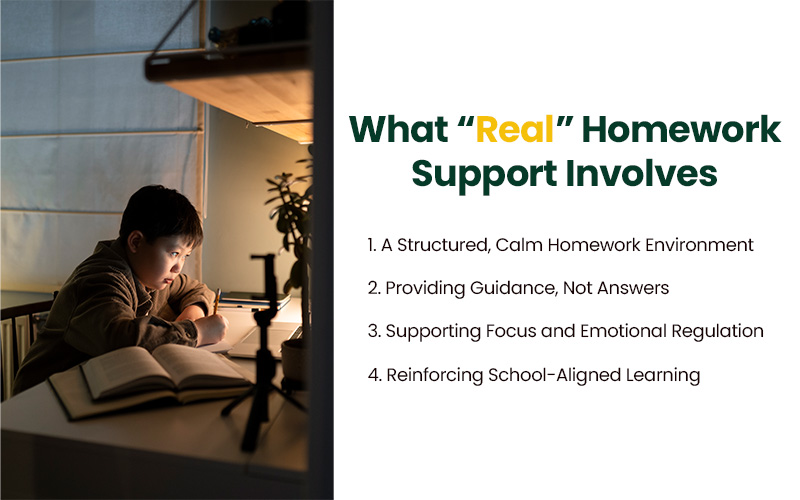
1. A Structured, Calm Homework Environment
Real support begins with the right environment. Homework should take place in a calm, supervised setting that is clearly separated from play and recreational activities. This physical and psychological separation helps children transition into “learning mode” without pressure.
Engaging in consistent, structured after-school routines reduces overwhelm, as children do not have to constantly decide what to do next or negotiate expectations. When the sequence of activities is predictable, it helps children to conserve their mental energy for learning. With clear boundaries, pacing, and a sense of security, they are better able to focus on one task at a time, even during periods of fatigue.
2. Providing Guidance, Not Answers
Instead of giving children answers directly, educators help them clarify instructions, ask prompting questions, and break problems into manageable steps. By encouraging children to think through their reasoning and check their own work, educators support understanding without taking ownership of the task away from the child.
Over time, this approach builds confidence and reduces dependence on adults. Children learn that uncertainty is part of the learning process and become more willing to attempt tasks independently. As a result, homework becomes an opportunity to practise problem-solving and self-reflection, rather than simply completing work for the sake of submission.
3. Supporting Focus and Emotional Regulation
Learning does not happen in isolation from emotions. Homework support also means recognising when a child needs reassurance, encouragement, or a short break. After-school care plays a part in helping children regulate emotions before returning to academic tasks.
In a calm, supervised environment, educators observe a child’s emotional state and respond early. When children show signs of fatigue, frustration, or disengagement, educators address this by offering reassurance or allowing short, purposeful breaks. This helps children reset emotionally, preventing after-school homework struggles from becoming emotionally charged experiences.
4. Reinforcing School-Aligned Learning
High-quality homework support is most effective when it is aligned with the after-school care curriculum and reinforces what children are learning in school. When academic support follows the same concepts, language, and expectations used in the classroom, children are less likely to feel confused or overwhelmed. Thanks to this alignment, children can see homework as a continuation of learning.
Academic enrichment programmes delivered by established partners aligned with the MOE syllabus provide this consistency. By emphasising key concepts using familiar methods and school-appropriate approaches, children can apply what they have learned correctly with greater confidence. Over time, this strengthened understanding reduces the risk of mixed messages or conflicting techniques.
What Makes Curos’ Homework Support Different?
Before exploring outcomes, let’s understand how Curos approaches homework support differently from traditional supervision models. At Curos, supporting children’s homework management is not treated as an add-on or a task to be rushed through. It becomes a core part of the daily after-school experience, intentionally built into each child’s routine.
We recognise that homework time often takes place when children are tired, overwhelmed, or unsure where to begin, especially during the hours when parents are still at work. Instead of focusing solely on task completion, we emphasise habit-building, confidence, and the gradual development of long-term independence in managing schoolwork.
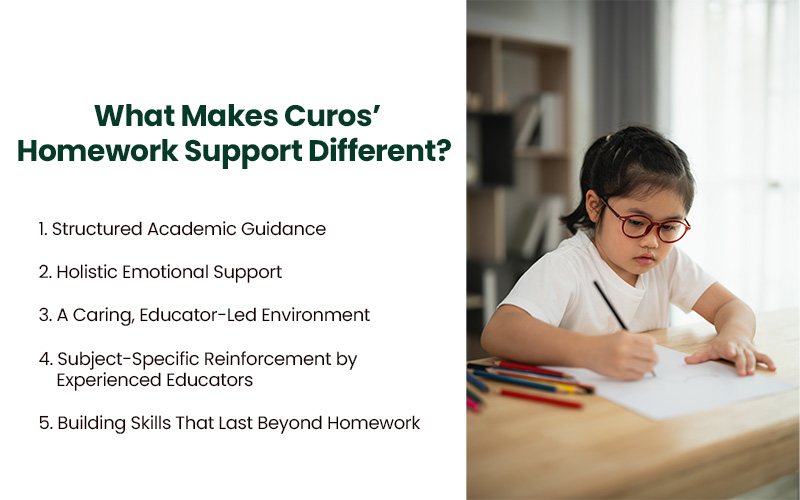
1. Structured Academic Guidance
Homework is guided by our trained educators who help children understand instructions, organise tasks, and approach their work step by step. This structure reduces confusion, prevents rushing, and encourages thoughtful problem-solving rather than guesswork.

2. Holistic Emotional Support
We recognise that emotional readiness directly affects learning. Our educators support your child when they feel tired, frustrated, or anxious, helping them regulate emotions and remain engaged without pressure. This creates a calmer, more positive homework experience.
3. A Caring, Educator-Led Environment
Homework takes place in a safe, supervised setting where children feel supported. Our educators guide, clarify, and encourage, helping your child build confidence so they can gradually reduce over-reliance on adults for answers.
4. Subject-Specific Reinforcement by Experienced Educators
Where needed, subject specialists with experience in areas such as Upper Primary Mathematics and Science are involved to reinforce concepts accurately. Our educators focus on clarifying misconceptions and strengthening conceptual understanding in a way that aligns with school expectations.
5. Building Skills That Last Beyond Homework
Through consistent routines and guided practice, we help your child develop skills that support learning well beyond daily homework tasks. By experiencing structured expectations and calm guidance each day, children gradually learn how to manage their work independently without relying on constant reminders or supervision. In the long run, this approach strengthens independent study habits. Children can then improve focus and task management while becoming more confident in approaching challenging work.
On top of that, children also develop healthier attitudes towards learning, seeing effort and problem-solving as part of the process. These foundational skills extend beyond homework, supporting long-term academic growth, resilience, and self-directed learning as children progress through school.
Through consistent routines and guided practice, we help your child develop:
- Independent study habits
- Improved focus and task management
- Confidence in approaching unfamiliar work
- Healthier attitudes towards learning
These skills extend well beyond daily assignments, supporting long-term academic growth.

Why This Matters for Working Parents
For parents, especially those balancing full-time work, quality student care in Singapore
plays an important role in reducing household stress. It should support children during the after-school hours, when they are most in need of structure and guidance. When homework is guided and managed earlier in the day, parents are not left handling tired, overwhelmed children late at night, allowing evenings to remain calmer and more balanced for the family.
As a result, homework-related conflicts at home are reduced, and children return home calmer and more confident. Besides, evenings can be spent reconnecting as a family without struggling to correct schoolwork or manage unfinished tasks.
Frequently Asked Questions
1. What is the difference between homework completion and homework excellence?
Homework completion focuses on getting something written down, regardless of accuracy or understanding. Homework excellence, supported by effective homework support, emphasises comprehension, correct application, and the ability to explain reasoning. This approach ensures children understand what they are doing, not just that something is submitted.
2. How does Curos help children who are easily frustrated or distracted during homework?
Curos educators are trained to recognise when a child needs encouragement, reassurance, or a short break. By supporting emotional regulation alongside academic guidance, our educators support children in re-engaging without pressure.
3. How does homework support at Curos align with what children learn in school?
Curos’ academic enrichment programmes are delivered by established partners aligned with the MOE syllabus. This reinforces classroom learning in an effective way.
Conclusion
Homework does not have to be a daily source of frustration or tension. When children receive the right after-school homework support in a structured and emotionally supportive environment, managing homework becomes a chance to build confidence, independence, and positive learning habits.
As a dependable student care centre, Curos intentionally integrate homework support into our programmes. By combining structured academic guidance, holistic emotional support, and a caring, educator-led environment, we help children approach homework with greater confidence and resilience, allowing families to spend evenings connecting instead of correcting.
Encourage your child to experience our meaningful, structured after-school care, with accessible student care locations, including those in Bukit Timah. Our holistic after-school programmes are thoughtfully designed to support academic learning, build independence, and nurture emotional well-being.
Contact us to learn how we can enrich your child’s learning journey.